Red Poppy Seeds

Papaver Rhoeas
Regular price $6.99
Regular price $9.99 Sale price $6.99
Sale Sold out
Pack Size
40% OFF - The Best Value
50% OFF - The Best Value
Quantity
View full details

About

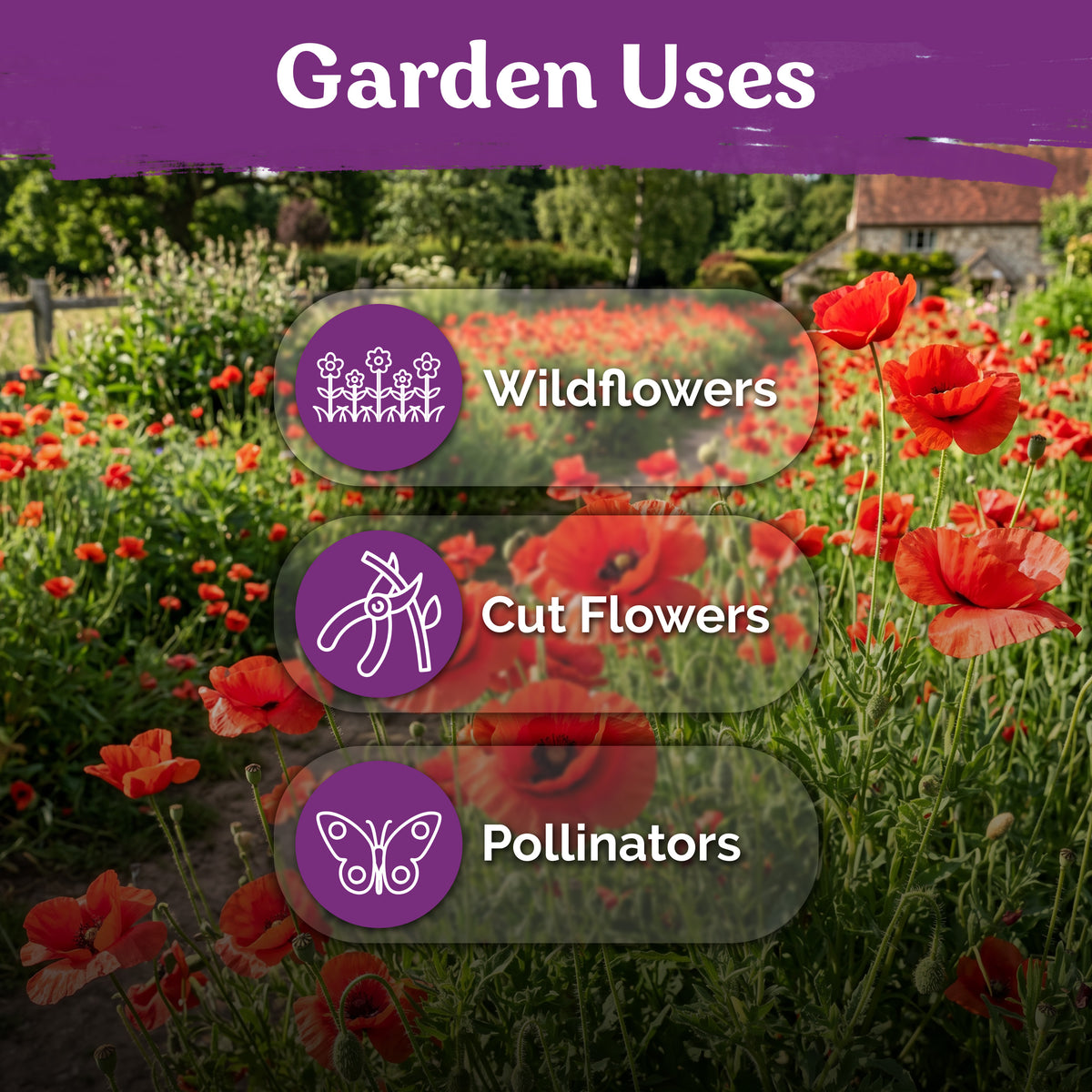
Red Poppy (Papaver Rhoeas) is a cool-season annual native to Europe, Western Asia, and North Africa. The flowers are tissue-thin, typically 2–3 inches across, with four overlapping scarlet petals and a dark center. It self-sows aggressively, which means one good planting can turn into a returning display year after year without you doing much. Grows in USDA Zones 3–9 as a direct-sown annual; in mild-winter climates (zones 7–9), fall sowing gives you earlier spring bloom. Use it in wildflower meadows, cottage borders, or massed in drifts — it's one of those flowers that looks better at scale than as a specimen.

Quick Facts

Life Cycle
Life Cycle Annual
USDA Zones
USDA Zones 03–10
Light Requirements
Light Requirements Full sun; Part sun
Germination Time
Germination Time 10-20 days
Stratification
Stratification Not required
Spacing
Spacing 6-12 inches
Sowing Method
Sowing Method Direct Sow
Soil
Soil Sandy; Loamy
Flowering Period
Flowering Period Summer
Water Requirements
Water Requirements Moderate (regular watering)
Maturity Time
Maturity Time 60-90 days
Growing Habit
Growing Habit Upright

How to Grow & Harvest

Sowing & Timing

Red Poppy seeds need light to germinate, so don't bury them. Scatter on bare, lightly raked soil and press in with your palm or a board, but leave them uncovered. Sow in early spring as soon as the ground is workable, or in fall for earlier bloom the following year. Red Poppy flower seeds germinate in 10-20 days when soil temperature is 50–65°F. Thin seedlings to 6–8 inches apart once they're an inch tall — crowding leads to leggy stems and less flowering. 

Soil, Watering & Fertilization

Full sun is non-negotiable for strong stems and good color saturation. These are field plants — they evolved in disturbed, lean agricultural soils, so rich amended beds actually give you more foliage but less flowers. Red Poppy seeds prefer well-drained, average-to-poor soil with a slightly alkaline pH (6.5–7.5). Water heirloom Red Poppy seeds regularly during establishment, but once they're set, overwatering weakens the stems. Established plants are drought-tolerant, so you may skip watering.

Growth & Harvest

Deadhead spent blooms to extend the flowering period — or don't, if you want them to self-sow. Those are actually two different garden strategies, and both work. For cut flowers, harvest when buds are just showing color but haven't opened yet; sear the stem ends in boiling water for 20–30 seconds immediately after cutting to seal the latex and extend vase life to 5–7 days.

FAQ

Are KVITER Red Poppy seeds non-GMO?

Yes. KVITER's Red Poppy seeds for sale are open-pollinated, heirloom, and non-GMO. No coating, no pesticides, just premium seeds.

Is this a good bulk option for wildflower meadows or large areas?

That's exactly what 6,500 seeds is designed for. At a typical sowing rate of 1–2 grams per square meter, this quantity covers a substantial meadow planting or a long naturalized border. 

What are good companion plants?

Cornflowers and Chamomile are the classic meadow companions — they bloom on a similar schedule and tolerate the same lean soils. Larkspur works well too. In a cottage border, plant alongside alliums or hardy geraniums that fill in once the poppies go dormant in summer.

Is Papaver Rhoeas the same as the opium Poppy?

No. Papaver Rhoeas (the corn Poppy or Flanders Poppy) is a completely different species from Papaver somniferum. It has no narcotic properties and is legal to grow everywhere without restriction.